本文為英文原文。繁體中文版尚在籌備中。

How AYANA Bali's Circular Composting System Works

| Stage | What Happens | Where It Comes From / Goes |
|---|---|---|
| 1. Collection | Organic waste from across the property — including crop trimmings, garden cuttings, and horse manure from the resort stables — is separated and directed toward the compost facility. The farm also sources rice straw, husks, and manure from local Balinese farmers. | Farm harvests, landscaping, resort operations, stables, local Balinese farmers |
| 2. Composting | Material is composted on-site using a combination of hot composting, worm composting, and compost tea, using only natural materials and processes. | On-site compost facility within the farm |
| 3. Soil Enrichment | Finished compost is returned to the farm beds, rebuilding organic matter and microbial life across our growing plots. | Farm plots growing 130+ plant varieties |
| 4. Chemical-Free Growing | Enriched soil supports healthy crops without synthetic fertilisers or pesticides. | Vegetables, herbs, and edibles used across AYANA's restaurants and bars |
| 5. Harvest & Table | Produce is harvested at peak ripeness and brought directly to our kitchens. | Resort dining, cooking classes, and farm-to-table experiences |
| 6. Back to Compost | Trimmings and unused plant material re-enter the composting cycle, completing the loop. | Full circle back to Stage 1 |


FAQ
Does AYANA Farm operate using organic farming principles?
Yes. AYANA Farm's growing practices are built on a chemical-free foundation — no synthetic fertilisers, pesticides, or soil treatments are used at any stage of the growing process. The farm's composting-led approach is designed to build soil health naturally and reduce reliance on synthetic inputs across the whole operation.
Does all the food at AYANA Bali come from the farm?
AYANA Farm contributes a meaningful and growing share of the fresh produce used across AYANA Bali's restaurants and bars. Because the farm prioritises biodiversity over volume — growing over 130 plant varieties — the focus is on seasonal, specialty, and heritage produce that supports the kitchens throughout the year.
Is AYANA Farm suitable for families with children?
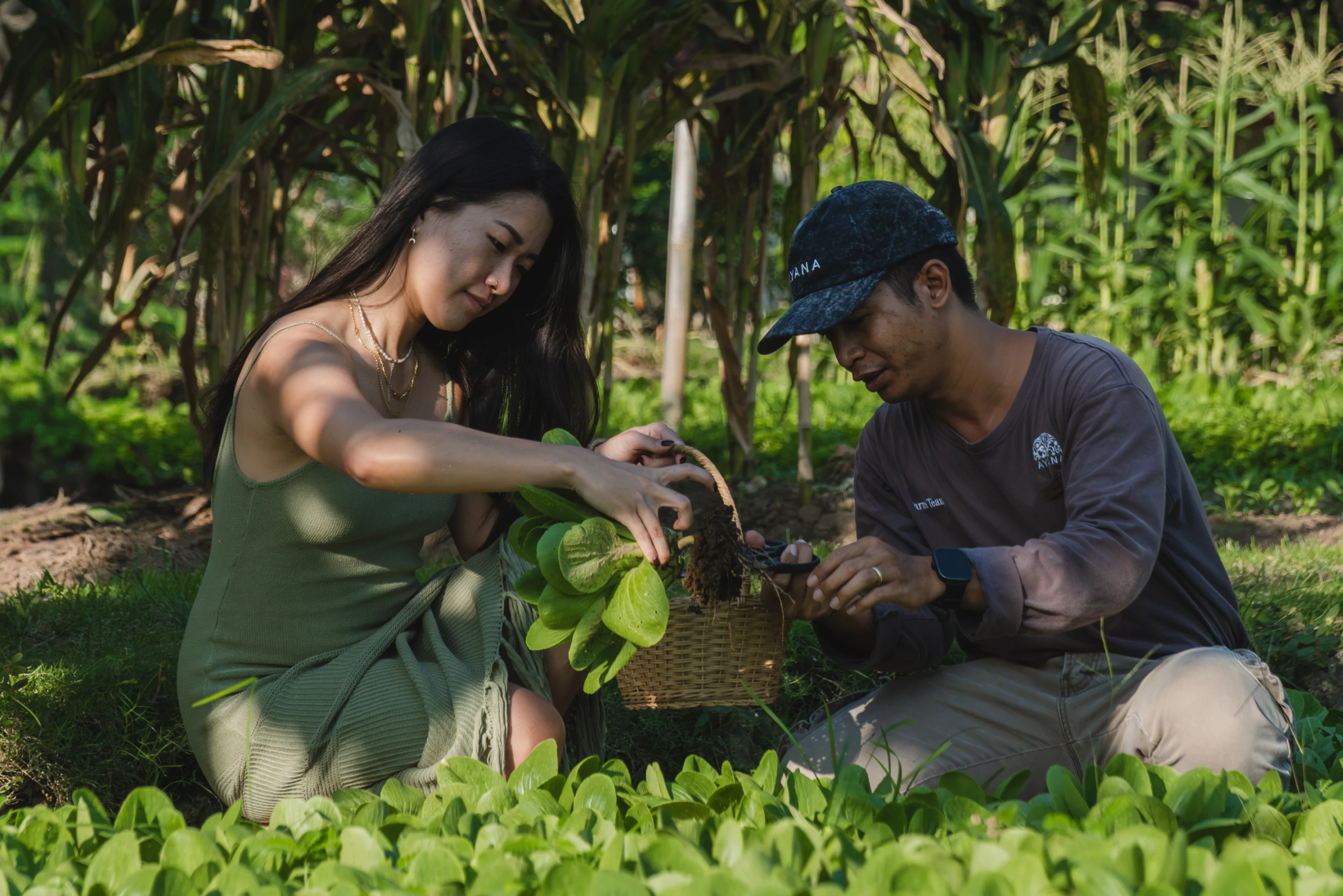
AYANA Farm is one of the most engaging parts of a family stay at AYANA Bali. Children can explore the compost beds, watch seedlings being planted, and follow the full journey of a plant's life cycle. The Root Ball Farm Experience is particularly well suited to younger guests, with hands-on participation built into every session. The AYANA Farm experiences page (https://www.ayana.com/bali/experiences/ayana-farm/) has full details on what is available for guest families and how to book.
Does AYANA Farm have educational programmes for children?
Yes — and they go well beyond a standard farm visit. Guidepost Montessori AYANA Bali, whose campus sits right next to AYANA Farm, brings children aged 18 months to 6 years to the farm every week as part of their regular curriculum. Each session follows the full growing cycle: students prepare the plant beds, sow seeds or start seedlings in the nursery, care for their plants week by week, and finally harvest and eat what they have grown. It is the same circular process that drives AYANA Farm's composting system — experienced directly, at child's pace, over a whole season. AYANA Farm also partners with Green Camp Bali, an outdoor education programme for children aged 7 to 12, which uses the farm as a living laboratory for sessions covering sustainable food practices, biodiversity, and hands-on nature skills.
How does AYANA Farm manage pests and plant disease without chemical pesticides?
At AYANA Farm, healthy soil is the first line of defence. Plants grown in fertile, biologically active soil are naturally more resilient to pest pressure and disease. Beyond that, the farm uses companion planting to deter pests and attract beneficial insects, and compost tea to introduce beneficial microorganisms that help crowd out harmful pathogens. AYANA Farm also produces its own natural pesticides on-site from plant-based ingredients. When intervention is needed, it is always through natural methods — never chemical.
What is jamu, and where does it feature at AYANA Farm?
Jamu is a traditional Indonesian herbal wellness practice with roots stretching back over a thousand years, recognised by UNESCO as an Intangible Cultural Heritage. At AYANA Farm, guests can explore this tradition directly through the Traditional Herbal Remedies experience. Participants harvest fresh ingredients from the farm's dedicated medicinal plant garden, learn about the health benefits of each plant, and are guided by an experienced herbalist from Jamu & Spice to create a jamu personalized to their own wellbeing — inside and out.
How long does the composting process take at AYANA Farm?
At AYANA Farm, composting timelines vary by method. Hot compost, when managed well and at the right temperature, can be ready in as little as two to three weeks. Vermicompost takes a little longer — typically around two to three months — but produces a particularly rich, dense humus that is especially valuable for seedlings. Compost tea is the quickest of the three; once the base compost is ready, a brew can be applied within 18-36 hours. Running all three methods in parallel means there is always finished compost at some stage of readiness at AYANA Farm, and the soil is never waiting long.
How does AYANA Farm know when compost is ready to go back into the soil?
At AYANA Farm, finished compost looks and smells nothing like what went in. It is dark, crumbly, and earthy — closer in texture to rich soil than to organic waste. The temperature of a hot compost pile also drops significantly once the material has fully broken down, which is one of the clearest indicators that it is ready. The team at AYANA Farm monitors the piles closely throughout the process, turning them regularly to maintain airflow and even decomposition. Patience at this stage matters as much as anything else — compost returned to the beds too early can harm plant roots rather than help them.
How do I book an AYANA Farm experience, and do I need to reserve in advance?
Advance booking is recommended for all AYANA Farm experiences, and required at least one day in advance for workshops and hands-on sessions as group sizes are kept small. Please note that some AYANA Farm experiences carry a cancellation fee — full details are available at the time of booking. Reservations can be made through the AYANA App under Experiences, by speaking directly with the front desk team at AYANA Bali, or by dialling 0 from anywhere on the property to reach the AYANA Call Centre. The full list of available experiences is on the AYANA Farm experiences page.